A Beginner Spanish News Roadmap for Real Reading
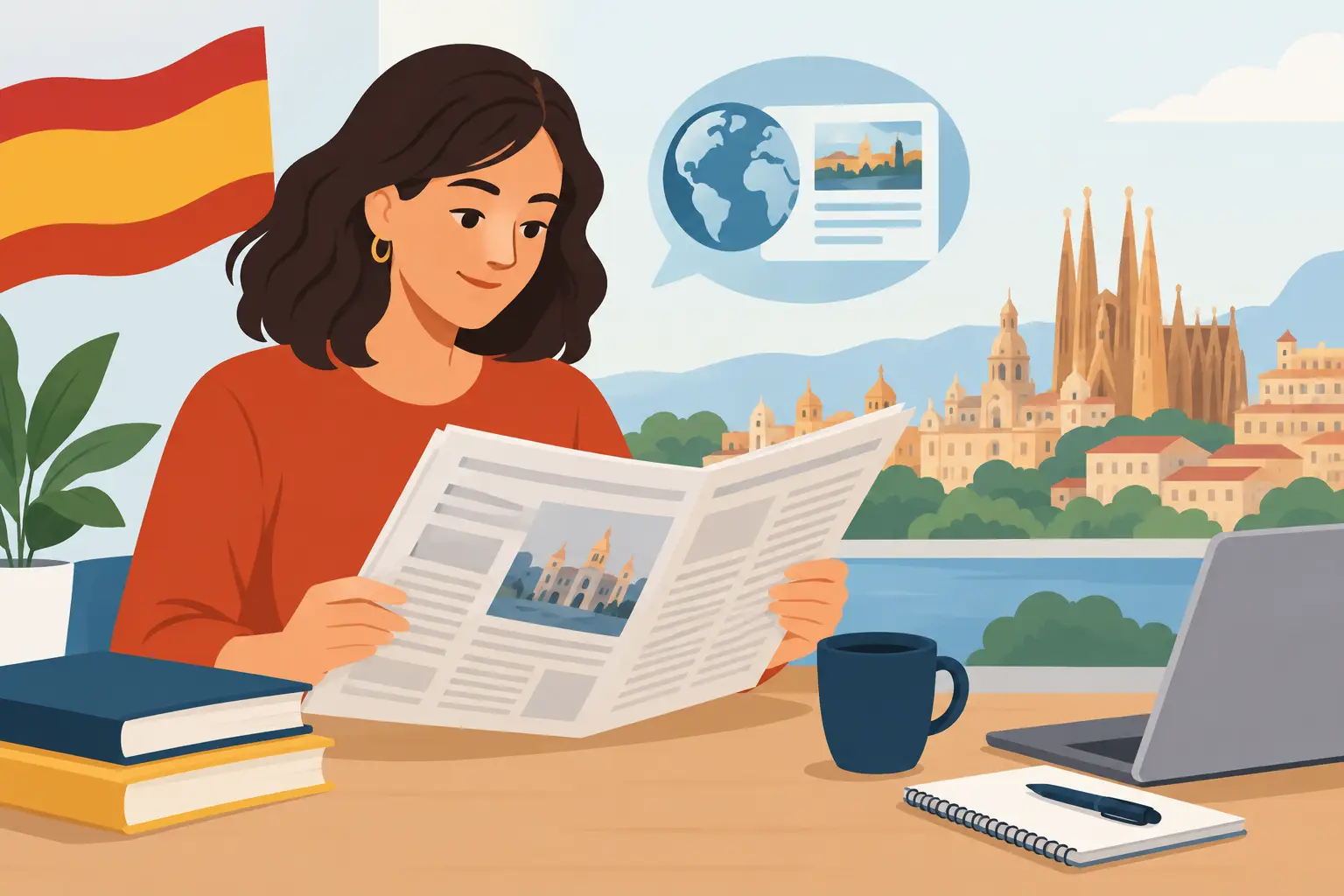
A Spanish headline can look like a wall of unfamiliar words until you notice what is already there: names, numbers, places, dates, and a few words that resemble English. That is the entry point. A beginner Spanish news roadmap is not about understanding every sentence from day one. It is about learning to extract meaning from real reporting, then returning often enough that the patterns stop feeling foreign.
Cartoon sentences will not help you read a headline about a storm, an election, a new phone, or a championship game. Real news will. The trick is choosing material at the right difficulty and giving yourself a repeatable way to handle what you do not know.
Why News Works for Beginning Spanish Readers
News is naturally structured for learners. Headlines are short. Stories answer familiar questions: who, what, where, when, and why. The same vocabulary returns across reports, especially within topics such as weather, business, sports, technology, and public life.
It also gives your practice a reason to exist beyond completing a lesson. You are not memorizing words for an imaginary café conversation. You are finding out what happened in Mexico City, following a football transfer, or understanding a story your Spanish-speaking colleague mentioned.
There is a trade-off. News moves quickly and often uses formal language, indirect phrasing, and political vocabulary that a beginner does not need immediately. That is why starting with the biggest story of the day is rarely the best move. Start small, choose concrete subjects, and let context do part of the work.
Your Beginner Spanish News Roadmap
1. Start with stories you could explain in English
For your first few weeks, favor reports about weather, local events, science, sports results, consumer technology, entertainment, and human-interest stories. These topics tend to include visible facts and repeatable vocabulary. A story about a heat wave might include temperatura, calor, lluvia, ciudad, personas, and autoridades. You can often grasp the frame before you translate a single verb.
Save complicated analysis, breaking political disputes, and opinion columns for later. They are valuable, but they demand more background knowledge and subtler grammar. Reading should feel challenging, not punishing.
Choose one topic you already care about. If you follow basketball, read basketball news. If you work in tech, read product launches and cybersecurity stories. Familiar knowledge reduces the language load, which leaves more attention for Spanish itself.
2. Read the headline before translating anything
Give yourself 20 seconds with the headline and image, if there is one. Look for cognates such as presidente, hospital, internacional, festival, or economía. Notice proper nouns and numbers. Then make a simple prediction in English: “This is probably about a new policy,” or “A team won a match.”
Predictions turn reading into a testable process. When you reach the first paragraph, you are not staring at a random sequence of words. You are checking an idea.
A headline may omit articles and use compressed grammar. That is normal. Do not treat every headline as a grammar exercise. Your goal is its basic claim: who did what, and where or when it happened.
3. Read once for the facts, not the details
On your first pass, resist the urge to tap every unknown word. Read the headline, the opening paragraph, and perhaps one or two short paragraphs after it. Ask only these questions: What happened? Who is involved? Is the event positive, negative, or unresolved?
If you can answer two of the three, the read was productive. You do not need complete comprehension to build reading fluency. In fact, expecting it too early trains you to stop whenever Spanish becomes real.
Use the article’s structure. The opening usually carries the key fact. Later paragraphs add background, quotes, numbers, and consequences. Beginners can leave some of that behind and still gain useful exposure.
4. Save words that earn a place in your memory
After the first read, look up only the words that blocked your understanding or seem likely to return. Aim for five to eight useful items from a short article, not 25 isolated definitions.
Prioritize high-value language: common verbs such as anunció, señaló, aumentó, and informó; connectors such as mientras, aunque, según, and tras; and topic words you expect to encounter again. Save the whole sentence with the word whenever possible. Context tells you whether a word is a noun, verb, or adjective and shows how native speakers actually use it.
This is where a reading tool matters. NewsLearner lets you adapt current Spanish articles to your level, tap unfamiliar vocabulary, and save it in its original sentence for later review. The useful loop is simple: read, save, review. Your saved words and reading activity stay on your device, so your learning history does not have to become another profile someone else owns.
5. Re-read the same article the next day
Most beginners make the same costly mistake: they read a new article every session and never return. New material is interesting, but re-reading is where your effort becomes recognition.
The next day, read the same piece without checking every saved word. You will notice phrases that were invisible on the first pass. A sentence like “Las autoridades informaron que no hubo heridos” may become instantly readable after you have seen autoridades, informaron, and heridos in context a few times.
Then read one fresh article on a related topic. This creates the right kind of repetition: not a sterile flashcard list, but familiar language appearing in new situations.
6. Build a 15-minute routine you can keep
A useful beginner Spanish news routine does not need an hour. It needs consistency. Try five minutes with one adapted article, five minutes saving and reviewing a small set of words, then five minutes re-reading yesterday’s story or reviewing saved vocabulary.
On a busy day, read one headline and one paragraph. On a longer commute, read two short stories in the same category. The plan should bend without breaking. Missing a day is not a failure; restarting with a smaller session is better than waiting for perfect focus.
Avoid measuring progress by how many articles you finish. Measure it by what has become easier. Can you identify the main event faster? Are certain verbs beginning to feel familiar? Can you recognize that a story is reporting a plan rather than a completed action? Those are real gains.
What to Learn First From Spanish News
Verbs carry the story
News reporting repeatedly relies on a compact set of action verbs. Learn common forms of decir, anunciar, informar, confirmar, aumentar, reducir, ocurrir, llegar, and continuar. You do not need a full conjugation chart before you start reading. Learn the form you see, connect it to its meaning, and notice it again later.
Past-tense reporting can feel intimidating, especially with forms such as fue, tuvo, dijo, and anunció. Treat them as reading vocabulary first. You can understand “El gobierno anunció nuevas medidas” long before you can comfortably produce every past tense in conversation.
Connectors reveal the logic
Small words often make the biggest difference. Porque explains cause. Pero introduces contrast. Mientras sets a time frame. Según signals a source. Tras means after, often in headlines. Sin embargo tells you the story is about to change direction.
If you understand these connectors, long sentences become easier to map even when several nouns are unknown. They show you how the facts relate.
Numbers, dates, and locations are free context
Train yourself to notice percentages, ages, money, dates, city names, and country names. A beginner often skips them because they are not “Spanish words,” but they can clarify the entire report. If you see 20%, millones, and the name of a company, you probably know the story involves business movement. That is meaningful comprehension.
When to Move to Harder Articles
Move up when adapted news feels mostly clear on a first read and you are saving fewer words because the language repeats. You do not need to wait until every article feels easy. A little friction is useful. Constant confusion is not.
Try a harder version of the same story before switching to an entirely new subject. Because you already know the event, you can focus on the extra phrasing, detail, and grammar. This is a more intelligent step up than jumping from a short weather report to a dense editorial.
If a story leaves you with no idea what happened, lower the level, pick a more concrete topic, or read a shorter piece. The issue is not that you are bad at Spanish. It is that the material is asking for too much at once.
Make the News Part of Your Spanish Life
The best roadmap is the one that fits around a life already in motion. Read a headline while waiting for coffee. Review saved words before a meeting. Return to a story on the train home. Small contact with Spanish, repeated around real events, builds a reading instinct that drills alone rarely create.
Your first goal is not to read like a journalist. It is to recognize that Spanish is becoming legible: one headline, one saved phrase, one familiar pattern at a time.